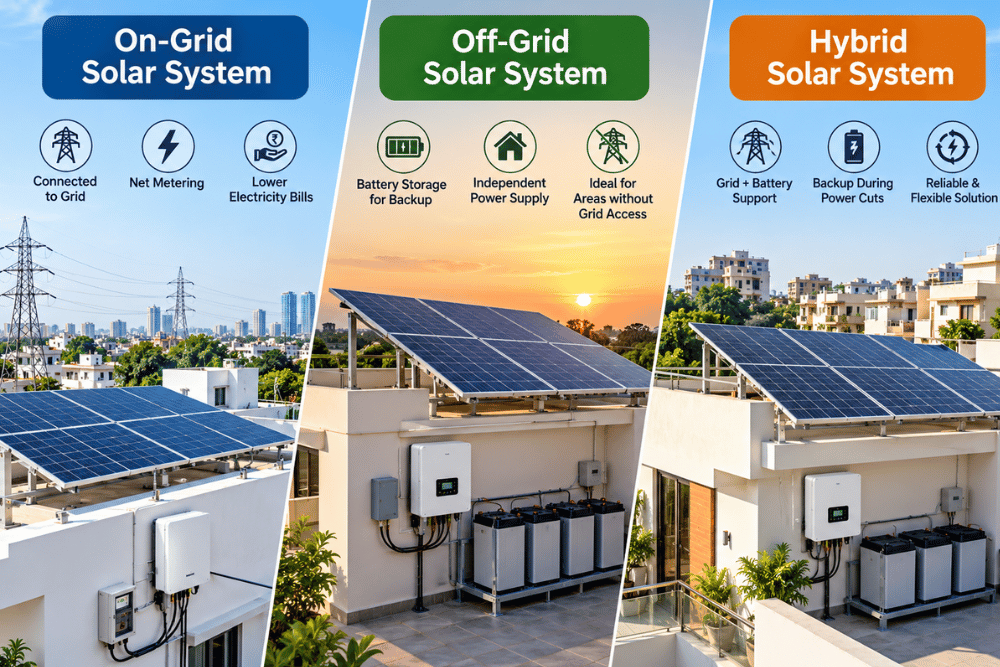
On-Grid vs Off-Grid vs Hybrid Solar Systems: Which Is Best?
Choosing the right solar power system is one of the most important decisions when planning a solar installation for your home or business. With growing interest in renewable energy across Delhi NCR, many property owners are exploring rooftop solar to reduce electricity expenses, make better use of available roof space, and become less dependent on conventional electricity. However, when researching solar panels, you will often come across three options: on-grid, off-grid, and hybrid solar systems. Although all three use sunlight to generate electricity, they work differently and serve different needs. Selecting the right option depends on your electricity consumption, budget, grid availability, and whether you need backup power during electricity outages.
For example, a homeowner in Delhi who mainly wants to reduce monthly electricity bills may benefit from an on-grid system, while a property in an area with unreliable grid electricity may require battery storage. A business in Gurugram that wants to lower its electricity expenses while keeping essential equipment running during outages may consider a hybrid system. There is no single solution that works best for every property, and choosing a system without understanding its features can lead to unnecessary expenses or unmet expectations. At Bhardwaj Solar Energy, we believe that understanding your energy requirements is the first step towards choosing reliable, sustainable, and high-efficiency solar power solutions. This guide explains the differences between on-grid, off-grid, and hybrid solar systems, their advantages and limitations, and the factors Delhi NCR customers should consider before investing in solar energy.
What Is an On-Grid Solar System?
An on-grid solar system, also known as a grid-connected solar system, is connected to the local electricity distribution network. It uses solar panels to generate electricity during daylight hours, while an inverter converts that electricity into a form suitable for household appliances and commercial equipment. The electricity generated can be used directly by the property, reducing the amount purchased from the utility grid. When solar generation is insufficient, the property draws additional electricity from the grid. Depending on the approved connection and applicable regulations, surplus electricity may be exported to the grid under the relevant metering and billing arrangement.
On-grid systems are often considered by homeowners and businesses that already have a reliable electricity connection and primarily want to reduce their electricity bills. For instance, a family living in an independent house in Rohini, Delhi, may use an air conditioner, refrigerator, fans, and other appliances during the day. If the rooftop solar system generates electricity while these appliances are running, the family can use solar power instead of purchasing the same electricity from the grid. This can help reduce grid consumption, particularly when daytime electricity demand is substantial. Offices, shops, schools, and other commercial properties with regular daytime operations may also find on-grid solar worth considering because their electricity usage can coincide with solar generation.
One of the main advantages of an on-grid system is that it generally does not require batteries, helping reduce the initial equipment cost and avoiding the additional maintenance and replacement considerations associated with battery storage. However, there is an important limitation: a conventional grid-connected solar system generally shuts down during a grid outage for safety reasons, even when sunlight is available. This means that installing ordinary on-grid solar panels does not automatically provide electricity during a power cut. Customers who need backup power should discuss suitable hybrid inverters, batteries, and approved backup configurations with their installer before selecting a system.
What Is an Off-Grid Solar System?
An off-grid solar system operates independently of the utility electricity network. It typically consists of solar panels, a suitable inverter, battery storage, and the necessary electrical protection equipment. The solar panels generate electricity during daylight hours, and any available surplus energy can be used to charge the batteries. When sunlight is unavailable or solar generation falls below the property's demand, the system can draw on the stored energy to supply compatible appliances. Because the property does not rely on the grid as its normal electricity source, the system must be designed carefully to meet electricity needs during cloudy weather, at night, and during periods of high consumption.
Off-grid solar can be useful for remote properties, agricultural locations, or buildings where grid electricity is unavailable or unreliable. Consider a farmhouse on the outskirts of Delhi NCR where the owner needs electricity for lighting, fans, a water pump, refrigeration, and other essential equipment but does not have a dependable grid connection. An appropriately designed off-grid system could provide a dedicated source of electricity, provided the solar array and batteries are sized to match the property's daily energy requirements. The owner must also consider how much electricity is needed during periods of limited sunlight and whether a backup generator or another source of power is necessary for extended periods of poor weather.
The main consideration with off-grid solar is that battery storage and system sizing are essential rather than optional extras. A system designed only around average daily consumption may not provide enough power during several cloudy days or periods when appliances use more electricity than expected. Battery capacity, usable battery energy, inverter output, charging requirements, and the type of appliances connected to the system all influence performance. For example, operating an air conditioner, a water pump, and several other high-power appliances together may require a considerably different design from one intended mainly for lighting, fans, and small electronic devices. Although off-grid solar can provide greater independence from the grid, the initial investment may be higher because of the additional equipment and storage capacity required.
What Is a Hybrid Solar System?
A hybrid solar system combines solar panels and battery storage with a connection to the utility grid. Depending on the equipment and system configuration, solar electricity can power household or commercial loads, charge the batteries, and reduce the amount of electricity drawn from the grid. When solar generation is insufficient, the system can use stored energy or draw electricity from the grid according to its design and operating settings. If a compatible backup arrangement is installed, the system can also supply selected appliances during a grid outage.
Hybrid solar is worth considering for customers who want to reduce electricity bills while also having backup power available for essential equipment. For example, a family in Noida may experience occasional electricity outages and want to keep lights, fans, internet equipment, and a refrigerator running when the grid supply fails. A properly designed hybrid system with a suitable battery and backup circuit could help meet those needs. The installer would need to calculate the power requirements of the appliances that must operate during an outage and determine how long the battery should support them. It is important to distinguish this essential-load arrangement from a system intended to power every appliance in the house, as running air conditioners and other high-power equipment can require substantially more capacity.
Hybrid systems offer flexibility, but they generally cost more than comparable on-grid installations without batteries because they include additional equipment and storage. Batteries also have a finite service life and may eventually need replacement, depending on the technology, usage, operating conditions, and manufacturer's specifications. Customers should therefore evaluate both the initial investment and the ongoing costs before deciding whether backup capability is worth paying for. A hybrid system is not automatically the best choice for every household; its value depends on how frequently backup power is needed, which appliances must remain operational, and the financial benefit expected from solar generation.
On-Grid vs Off-Grid vs Hybrid Solar: Key Differences
The most important difference between these three systems is how they use the electricity grid and whether they include battery storage. An on-grid system is generally suited to properties with an existing grid connection that want to reduce purchased electricity. An off-grid system is designed to operate independently of the utility network and therefore requires enough generation and storage to meet demand when sunlight is unavailable. A hybrid system combines a grid connection with battery storage and can be configured to provide both bill savings and backup power. These distinctions matter because two properties with similar electricity bills may need different solar solutions depending on their location, power reliability, and expectations during an outage.
In terms of initial cost, an on-grid system without batteries is often the least expensive of the three options for a comparable solar capacity. Off-grid and hybrid systems usually require a greater investment because batteries and compatible equipment add to the overall cost. However, price alone should not determine the decision. A property without reliable grid electricity may need an off-grid system despite the additional expense, while a homeowner who regularly experiences outages may consider the added cost of a hybrid system worthwhile. On the other hand, if the main goal is to reduce electricity bills and the grid supply is reliable, an on-grid system may be a practical starting point.
The systems also differ in how they handle electricity at night and during power cuts. An ordinary on-grid system without battery storage relies on grid electricity when the panels are not producing power and generally stops supplying power during a grid outage. An off-grid system uses stored battery energy when solar generation is unavailable, while a hybrid system can use battery storage and may provide backup power through appropriately configured equipment. The amount of backup available depends on battery capacity, inverter limits, connected loads, and the system's operating settings. Before purchasing any system, customers should ask the installer to explain exactly which appliances will operate during an outage and for how long under the expected conditions.
Which Solar System Is Best for Homes in Delhi NCR?
For many homes in Delhi NCR, the choice starts with the reason for installing solar panels. If your main objective is to reduce monthly electricity expenses and your property already has a reliable grid connection, an on-grid system may be suitable. If you need electricity independently of the grid, an off-grid system may be more appropriate. If you want to reduce grid consumption and retain backup power for selected appliances during outages, a hybrid system may offer a better balance. The right choice should reflect your actual needs rather than the assumption that the most advanced or expensive option will always deliver the greatest value.
Imagine a family living in an independent house in Ghaziabad. The household receives regular grid electricity and wants to reduce its summer bills because air conditioning increases monthly consumption. If the family does not require backup power, an on-grid system may be worth evaluating first. Now consider a different household in Gurugram that works from home and needs uninterrupted power for internet equipment, fans, lighting, and selected appliances. If power outages are a recurring concern, a hybrid system with appropriately sized battery storage may be more suitable. These examples show why the same solar system should not automatically be recommended to every homeowner, even when the properties have similar rooftops.
Apartment residents should also consider roof ownership and installation permissions before selecting a system. In many residential societies, rooftops are shared spaces, and individual residents may need approval from the housing society or building management. Available roof area, shared electricity consumption, electrical connections, and local metering arrangements can influence the options available. A site assessment helps establish whether an individual rooftop installation, a shared system, or another approved arrangement is appropriate for the property.
Which Solar System Is Best for Shops and Commercial Properties?
Businesses should evaluate solar systems according to their operating schedules, electricity consumption, grid reliability, and the financial impact of an outage. An office or retail shop that operates mainly during daylight hours may be able to use a significant portion of its solar generation directly, making an on-grid installation worth investigating. A business that depends on uninterrupted power for essential equipment may also need battery storage or a separate backup solution. The appropriate design depends on whether the business wants to minimise electricity costs, maintain operations during outages, or achieve both objectives.
For example, a shop in Faridabad that uses lighting, computers, refrigeration, and air conditioning during the day may benefit from an on-grid system that supplies part of its normal electricity demand. A small office in Noida that needs internet connectivity, computers, and selected equipment to remain operational during a power cut may consider a hybrid system with a dedicated backup circuit. A warehouse or industrial facility may require a more detailed assessment because machinery, motor loads, electrical demand patterns, and connection requirements can make the design more complex. Commercial customers should request an assessment based on their electricity bills, operating hours, equipment requirements, and available rooftop space rather than choosing a system based solely on its advertised capacity.
What Affects Solar Installation Costs?
The cost of installing solar panels depends on system capacity, panel specifications, inverter type, mounting structures, wiring, electrical protection, roof conditions, and installation complexity. Battery storage can add significantly to the initial investment, so it is important to determine whether backup power is a genuine requirement. An installation on a straightforward residential rooftop may have different costs from a commercial project that requires additional structural work, specialised mounting arrangements, or electrical upgrades. The final quotation should clearly explain the equipment supplied, the installation work included, applicable approvals, warranties, and any additional charges.
Customers should also understand the difference between installation cost and long-term value. An on-grid system may have a lower initial cost, but a hybrid system may provide additional value to a household that regularly needs backup power. Similarly, an off-grid system may be necessary for a property that cannot rely on the grid. The most economical option is therefore the one that meets the property's requirements at an acceptable overall cost, not necessarily the one with the lowest purchase price. Requesting a generation estimate, reviewing warranty terms, and understanding future battery replacement requirements can help you compare options more realistically.
Eligible residential customers may also qualify for financial assistance under government rooftop solar initiatives, including the PM Surya Ghar: Muft Bijli Yojana, subject to the current scheme guidelines and applicable requirements. Eligibility and subsidy provisions should be verified through official government sources and the relevant electricity distribution company before making financial commitments. Do not assume that every solar system or commercial property qualifies for residential assistance, and do not include an unconfirmed subsidy in your financial calculation as though it were guaranteed.
How to Choose the Right Solar Installation Company
Choosing a reliable solar installation company is an important part of ensuring that your system is designed and installed correctly. Before accepting a quotation, ask the company to assess your roof, review your electricity consumption, explain the recommended system capacity, and provide a realistic estimate of expected generation. You should also understand the specifications of the panels and inverter, the quality of the mounting structure, the electrical protection arrangements, and the warranties provided for different components. A clear quotation should identify what is included in the installation so that you can compare different proposals fairly.
If you are considering a hybrid or off-grid system, ask for a detailed explanation of the battery capacity and the appliances it can support. For instance, a system intended to power fans, lights, and internet equipment during a short outage will have different requirements from one expected to operate an air conditioner and water pump. The installer should explain the expected backup duration under the stated load assumptions and clarify any limitations. For grid-connected systems, confirm the applicable approval and metering process with the relevant distribution company. These checks can help prevent misunderstandings and ensure that the system you purchase meets your expectations.
At Bhardwaj Solar Energy, our focus is on reliable, sustainable, and high-efficiency solar power solutions that help customers explore a suitable path towards renewable energy. Whether you own a home in Delhi, a family property in Ghaziabad, a shop in Noida, or a commercial building in Gurugram or Faridabad, the right starting point is a clear understanding of your energy needs. A carefully selected solar system can help reduce dependence on conventional electricity while providing the functionality that matters most to your property.
Frequently Asked Questions
Which solar system is best for a home in Delhi NCR?
An on-grid system may be suitable if your main goal is to reduce electricity bills and you have a reliable grid connection. A hybrid system may be more appropriate if you also need backup power, while an off-grid system is generally considered when independent operation is necessary.
Does an on-grid solar system work during a power cut?
A conventional on-grid system generally shuts down during a grid outage for safety reasons. Backup power requires compatible equipment and an appropriately designed system.
Is a hybrid solar system worth the extra cost?
It may be worthwhile if you need backup power during outages as well as lower grid consumption. The value depends on how frequently outages occur, which appliances need backup, battery capacity, and the overall installation cost.
Do off-grid solar systems need batteries?
Yes, battery storage is generally essential for an off-grid system because it must provide electricity when solar generation is unavailable. The battery capacity should be selected according to consumption and the required backup duration.
Can I install solar panels on my commercial property?
Many commercial rooftops can accommodate solar panels, subject to structural suitability, available space, electrical requirements, and applicable approvals. A professional assessment can help determine a suitable system capacity.
Are solar subsidies available for all three system types?
Subsidy eligibility depends on the specific government scheme, consumer category, system configuration, and current guidelines. Verify the applicable requirements through official sources before choosing a system or calculating the expected investment.
How do I choose the right solar system installer?
Look for a company that provides a site assessment, transparent quotations, suitable equipment, clear warranty information, realistic generation estimates, and appropriate installation and after-sales support.
Conclusion: Make the Right Solar Investment for Your Needs
On-grid, off-grid, and hybrid solar systems each serve a different purpose, and the right option depends on your electricity consumption, grid availability, budget, and backup requirements. An on-grid system is often worth considering when the main goal is reducing electricity bills, an off-grid system can suit locations that need independent electricity, and a hybrid system may be appropriate for customers who want both solar generation and backup power. Understanding these differences before installation can help you avoid unnecessary expenses and select a solution that meets your long-term requirements.
Before making your decision, review your electricity bills, assess your rooftop space, identify the appliances that need backup power, compare complete installation quotations, and verify any applicable government assistance. A well-planned installation should be based on realistic generation estimates, suitable equipment, and clear warranty terms rather than general promises about savings or performance. With the right planning and professional guidance, solar energy can become a practical investment in a more efficient and sustainable future.
Bhardwaj Solar Energy — Reliable, Sustainable, and High-Efficiency Solar Power Solutions for a Cleaner and Greener Tomorrow.
Planning Rooftop Solar in Sonipat or Delhi NCR?
Book a 100% Free Site Survey & get up to ₹78,000* PM Surya Ghar Subsidy assistance.